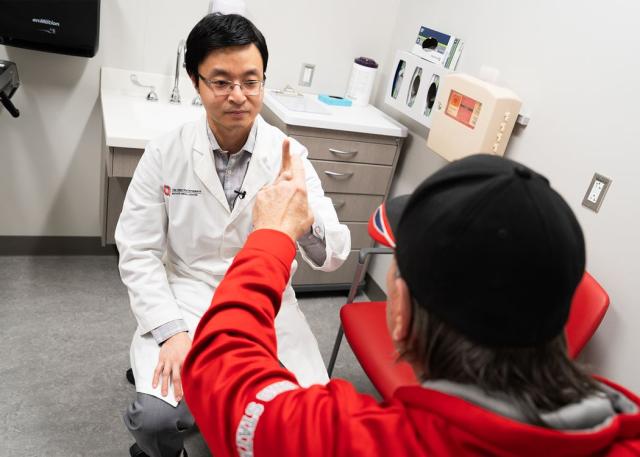
A new clinical trial led by Dr. Yinan Zhang in the OSU Department of Neurology is exploring a novel strategy to slow disability in progressive multiple sclerosis (MS) by targeting a fundamental process of aging. The study will evaluate whether removing harmful “aged” cells, known as senescent cells, can improve physical and cognitive function in older adults with the disease.
Nearly one million people in the United States are living with multiple sclerosis. Although current treatments can reduce relapses in the early stages of the disease, they are far less effective once it progresses. In this later phase, patients often experience gradual neurological decline, reduced mobility, and worsening cognitive function, with limited treatment options available. Increasingly, research suggests that aging processes play a key role in this transition. In particular, the buildup of senescent cells may drive chronic inflammation, impair tissue repair, and contribute to neurodegeneration.
“This trial is based on the idea that targeting aging mechanisms—not just the immune system—could open a completely new path for treating progressive MS,” the investigators note.
The trial is designed based on the geroscience principle, which proposes that targeting the underlying mechanisms of aging may improve multiple age-related conditions simultaneously. Participants enrolled in the trial will receive a combination of two drugs that work together to eliminate senescent cells: dasatinib, an FDA-approved cancer drug, and quercetin, a naturally occurring compound found in fruits and vegetables. The study aims to reduce senescent cell burden in the blood while focusing on clinically meaningful outcomes, including mobility, disability progression, and cognitive performance.
If successful, this study could pave the way for larger trials that expand treatment approaches for progressive MS by incorporating strategies that target the biology of aging.
Patients interested in this trial should email MSResearch@osumc.edu for more information. This trial is registered at ClinicalTrials.gov as NCT07270120.